 Lives of Scripture
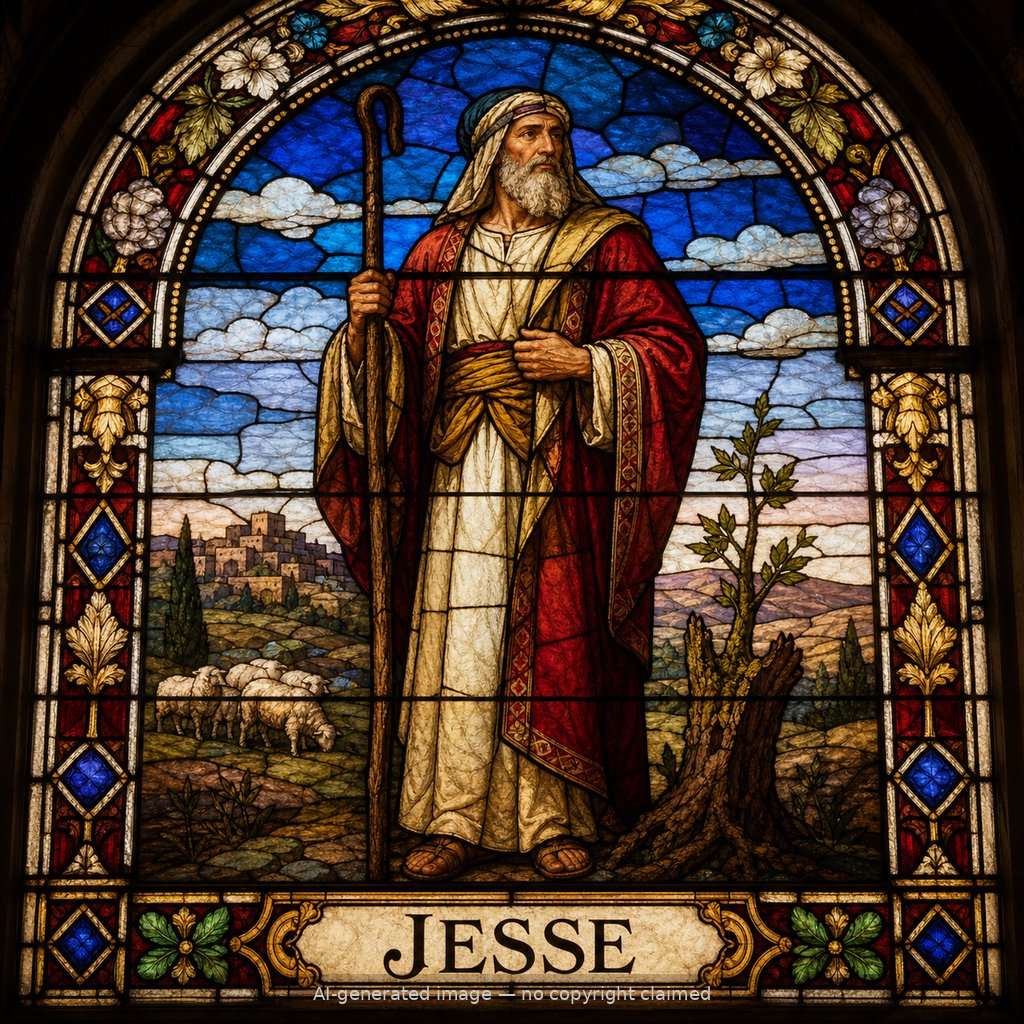
Jesse (M)
First named in Ruth 4:17-22
Jesse is introduced as the grandson of Boaz and Ruth, the point the book of Ruth's closing genealogy builds toward — an unremarkable Bethlehemite farmer who turns out to matter enormously to the biblical story (Ruth 4:17-22). When the prophet Samuel came to Bethlehem to anoint Israel's next king from among Jesse's sons, Jesse paraded seven before Samuel, beginning with the eldest, Eliab, whom Samuel assumed must be the one — until God corrected him: 'man looks at the outward appearance, but the LORD looks at the heart.' All seven were rejected (1 Samuel 16:6-10). Jesse had not even thought to call in his youngest son, David, from tending sheep, an omission Scripture records without comment, quietly reinforcing God's point (1 Samuel 16:11). Once sent for, David was anointed on the spot, his brothers looking on (1 Samuel 16:13). Later, Jesse's own errands put David at the center of Israel's history again: he sent David to the battle lines with food for his brothers, the trip during which David met Goliath (1 Samuel 17:12-20). Centuries afterward, Isaiah named Jesse directly in a messianic prophecy — not David, but Jesse, the obscure farmer: 'a shoot will spring from the stem of Jesse... the nations will resort to the root of Jesse' — underscoring that the coming King would arise from God's own choice rather than human greatness (Isaiah 11:1, 10; Romans 15:12). Jesse also had two daughters whose sons became prominent military commanders under David, his own nephews (1 Chronicles 2:13-17).
Thought for Today
Jesse paraded seven strong sons before Samuel and never thought to call the youngest in from the sheep, yet God chose the one no one else considered, saying He looks at the heart, not the outward appearance. Jesus was overlooked the very same way, born in a manner nobody expected of a king.
References: Ruth 4:17-22; 1 Samuel 16:1-13; 1 Samuel 17:12-20; Isaiah 11:1,10
Genealogy
Connections
Places
- Bethlehem — the Bethlehemite whose youngest son David was anointed king here
1 Samuel 16:1