 Lives of Scripture
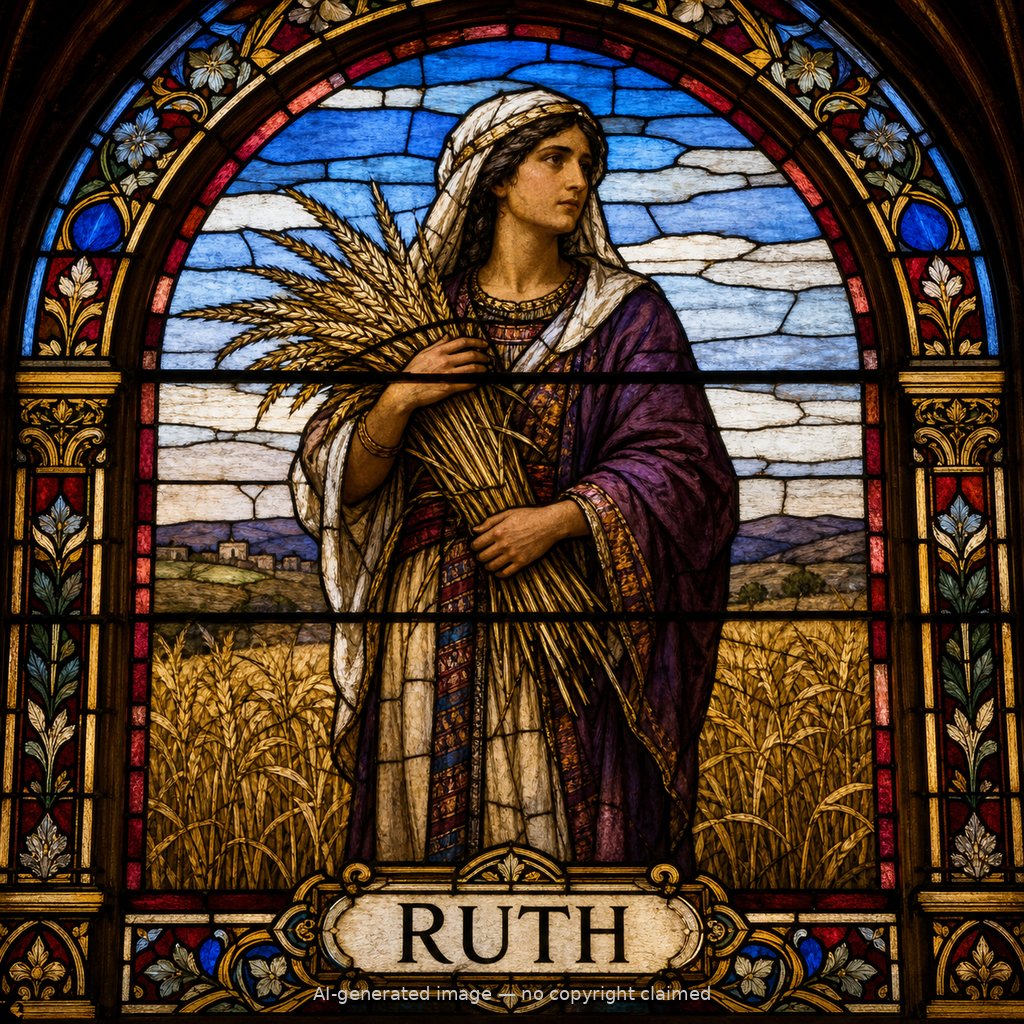
Ruth (F)
First named in Ruth 1-4
Ruth was a Moabite widow, married into an Israelite family that had settled in Moab during a famine, who lost her husband Mahlon along with her father-in-law and brother-in-law, leaving her mother-in-law Naomi without support (Ruth 1:1-5). When Naomi decided to return to Bethlehem and urged her daughters-in-law to stay behind and remarry among their own people, Ruth refused, binding herself to Naomi, Naomi's people, and Naomi's God in one of Scripture's most quoted statements of loyalty (Ruth 1:16-17). This was no small thing — Moabites were barred by the law of Moses from Israel's assembly for ten generations (Deuteronomy 23:3-6) — and Ruth's story is partly about God's grace overriding that exclusion (Ruth 2:12). In Bethlehem, Ruth supported herself and Naomi by gleaning grain, coming under the notice of Boaz, a relative of Naomi's late husband, whose kindness went beyond what the law required (Ruth 2). Naomi recognized Boaz as a potential kinsman-redeemer and guided Ruth through the culturally coded process of asking him to fulfill that role, which he did after a nearer relative declined (Ruth 3-4). Ruth is never shown converting in an evangelistic sense; the text presents her covenant loyalty as already settled fact, treating her faith the way it treats Abraham's — trust credited without a conversion narrative. Her marriage to Boaz produced Obed, grandfather to Jesse and great-grandfather to David — a Moabite woman becoming, by God's providence, the great-grandmother of Israel's greatest king (Ruth 4:13-22; Matthew 1:5).
Thought for Today
Boaz used his own resources to rescue Ruth and Naomi from poverty they couldn't escape alone. Jesus is our greater Redeemer, rescuing us the same way.
References: Ruth 1-4; Matthew 1:5
Genealogy
Connections
- Ancestor of Christ (Matthew 1:5)
- Ruth (F) — bore → Obed (M)
- Mahlon (M) ↔ married ↔ Ruth (F)
- Boaz (M) ↔ married ↔ Ruth (F)
- Naomi (F) ↔ guided ↔ Ruth (F)
Naomi guided Ruth into Boaz's field and devised the plan that led to Ruth's marriage to him; Ruth in turn bound herself permanently to Naomi and to Naomi's God rather than return to Moab.
Ruth 1:16-17; Ruth 3:1-4