 Lives of Scripture
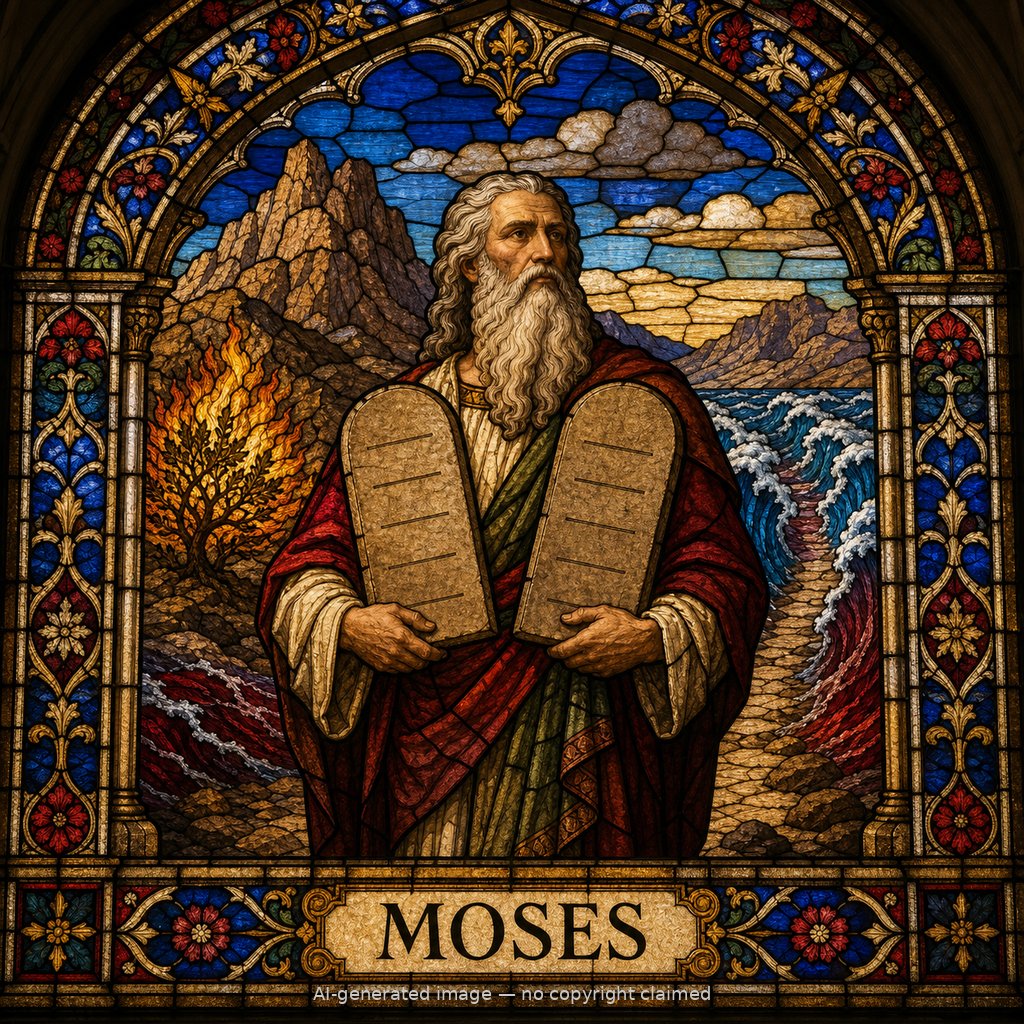
Moses (M)
First named in Exodus 2-40
Moses was born under a death sentence — Pharaoh had ordered every Hebrew infant son drowned — and survived because his mother hid him, then set him adrift in a basket where Pharaoh's own daughter found and raised him at court (Exodus 1:22-2:10). At forty, seeing an Egyptian beating a Hebrew slave, Moses killed the Egyptian and fled into the wilderness (Exodus 2:11-15). He spent forty years as a shepherd in Midian, marrying Zipporah, before God met him at a burning bush and commissioned him to demand Pharaoh let Israel go — a task Moses resisted until God provided his brother Aaron as a spokesman (Exodus 3-4). Through Moses, God struck Egypt with ten plagues, instituted the Passover, and led Israel out through the Red Sea (Exodus 5-14). At Sinai, Moses received the Law and mediated the covenant, a role the New Testament treats as a real but incomplete forerunner of Christ's mediation (Exodus 19-24; Hebrews 3:1-6). Moses was not sinless: he pleaded successfully for Israel after the golden calf, yet later, provoked at Meribah, struck the rock in anger instead of speaking to it as commanded, taking credit alongside God for the water — serious enough that God barred him from the promised land he had led Israel toward for forty years (Numbers 20:1-13; Deuteronomy 34:1-8). Moses died on Mount Nebo, seeing the land only from a distance; Scripture records no prophet like him arose again until the greater one the Law itself anticipated (Deuteronomy 34:10-12; Acts 3:22).
Thought for Today
Moses led God's people out of slavery in Egypt. Jesus leads us out of something even bigger — sin itself. Whatever has us trapped, may we remember He's the one who can truly set us free.
References: Exodus 2-40; Numbers; Deuteronomy 34
Genealogy
Connections
- A type of Christ (John 3:14)
- Prophesied of Christ (John 5:46)
- Witness to Christ (Luke 9:30-31)
- Amram (M) — begot → Moses (M)
- Jochebed (F) — bore → Moses (M)
- Moses (M) — begot → Gershom (M)
- Moses (M) ↔ married ↔ Zipporah (F)
- Moses (M) — begot → Eliezer (M)
- Aaron (M) ↔ collaborated with ↔ Moses (M)
Aaron served as Moses' spokesman before Pharaoh and co-led Israel through the Exodus, though he also built the golden calf in Moses' absence.
Exodus 4:14-16; Exodus 7:1-2; Exodus 32
Places
- Egypt — born here under Pharaoh's death decree, and later led Israel out
Exodus 2:1-10; Exodus 12:31
- Midian — fled here from Egypt and kept Jethro's flock for forty years
Exodus 2:15-21
- Plains of Moab — gave the addresses of Deuteronomy here and viewed the promised land
Deuteronomy 1:5; Deuteronomy 34:1
- Sinai — received the Law and the covenant from God here
Exodus 19:20; Exodus 24:12