 Lives of Scripture
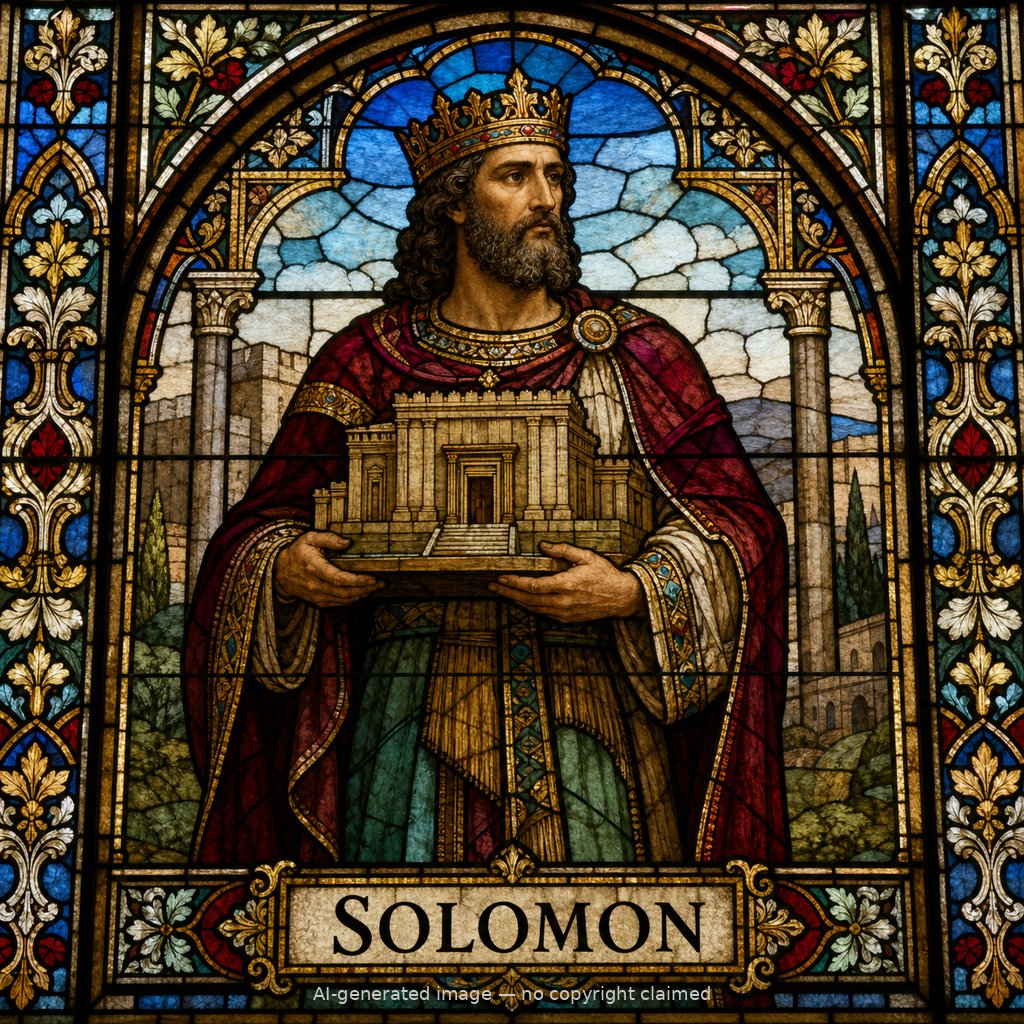
Solomon (M)
First named in 2 Samuel 12:24-25
Solomon succeeded David after a contested succession in which his older half-brother Adonijah tried to seize the throne first, blocked by the prophet Nathan and Solomon's mother Bathsheba (1 Kings 1). Early in his reign, God appeared to Solomon in a dream and offered him anything he asked; Solomon requested 'an understanding heart to judge Your people' rather than long life or riches, and God granted both wisdom and, unasked, riches and honor besides (1 Kings 3:5-14). He demonstrated that wisdom at once, resolving a dispute between two women over an infant by proposing to divide it, exposing the true mother by her willingness to give him up (1 Kings 3:16-28). Over seven years, Solomon built the temple in Jerusalem, fulfilling the plan God had given David but not permitted him to build (1 Kings 5-8). His wisdom and wealth became internationally famous, drawing the Queen of Sheba to test him with hard questions, all answered to her astonishment (1 Kings 10:1-13). Scripture is direct about what followed: Solomon loved many foreign women the Law had warned against marrying, and by old age his seven hundred wives and three hundred concubines turned his heart after Ashtoreth, Milcom, and Chemosh, for whom he built high places facing Jerusalem (1 Kings 11:1-8). God's judgment followed: the kingdom would be torn from his son, though not entirely and not in Solomon's lifetime, for David's sake — the split between Israel and Judah that came right after his death (1 Kings 11:9-13; 12).
Thought for Today
God offered Solomon anything, and he asked only for an understanding heart to judge God's people rather than riches or long life. Jesus is the wisdom Solomon only glimpsed, and something greater than Solomon really is here.
References: 2 Samuel 12:24-25; 1 Kings 1-11; 2 Chronicles 1-9; Proverbs 1:1; Ecclesiastes 1:1
Genealogy
Connections
- Ancestor of Christ (Matthew 1:6-7)
- A type of Christ (Matthew 12:42)
- David (M) — begot → Solomon (M)
- Bathsheba (F) — bore → Solomon (M)
- Solomon (M) — begot → Taphath (F)
- Solomon (M) — begot → Basemath (F)
- Solomon (M) — begot → Rehoboam (M)
- Bathsheba (F) — secured the throne for → Solomon (M)
When David was old and Adonijah moved to seize the throne, Bathsheba went to David at Nathan's urging and secured his public confirmation that Solomon would reign.
1 Kings 1:11-31
- Nathan (M) — anointed → Solomon (M)
Nathan helped secure Solomon's succession over Adonijah's attempted coup, then anointed him king at Gihon.
1 Kings 1:11-39