 Lives of Scripture
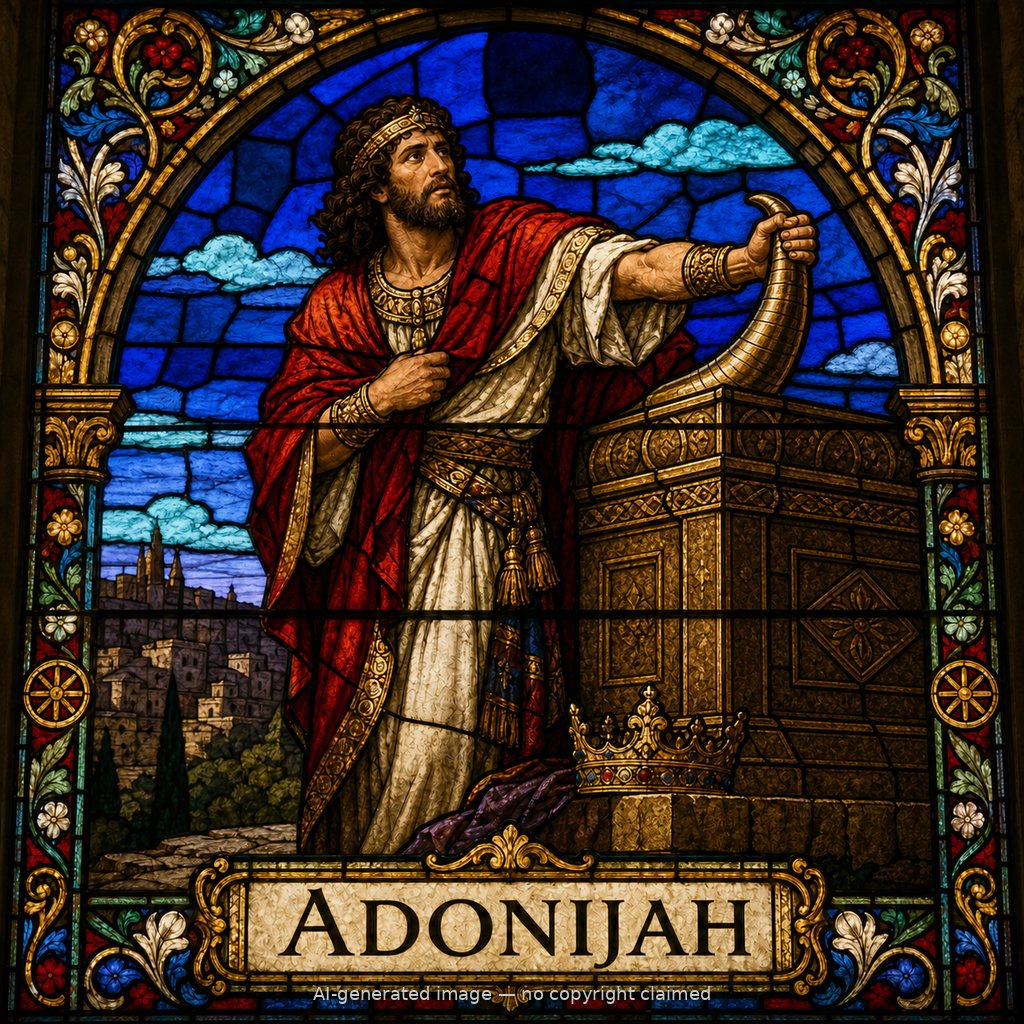
Adonijah (M)
First named in 2 Samuel 3:4
Adonijah, David's fourth son and, after Absalom's death, the presumed heir by age, declared himself king while David was still alive but old and failing, gathering chariots, horsemen, and the support of Joab and the priest Abiathar for a public coronation feast (1 Kings 1:5-10). Nathan the prophet and Bathsheba moved quickly, reminding David of his earlier promise that Solomon would reign, and David immediately had Solomon anointed king at Gihon, undercutting Adonijah's claim before it could take hold (1:11-40). Hearing the trumpets and celebration for Solomon, Adonijah's guests scattered in fear, and Adonijah himself fled to the altar, grasping its horns for sanctuary until Solomon swore to spare him if he proved himself "a worthy man" (1:49-53). Solomon released him to go home in peace. But after David's death, Adonijah asked Bathsheba to request that Solomon give him Abishag, David's attendant in his final days, as a wife -- a request Solomon read as a renewed and calculated claim to the throne, since taking a former king's concubine carried royal implications in the ancient Near East (2:13-22; compare Absalom's similar act in 2 Samuel 16:22). Solomon had him executed immediately for it, closing out a life defined by grasping prematurely for a throne that was never his to take (1 Kings 2:23-25).
Thought for Today
Adonijah crowned himself king before his father had chosen an heir, then ran for the altar in terror the moment his scheme collapsed. We don't have to seize what God hasn't given us; Jesus' throne was appointed by the Father from the start, not grabbed early out of fear of missing it.
References: 2 Samuel 3:4; 1 Kings 1:5-51; 1 Kings 2:13-28; 1 Chronicles 3:2