 Lives of Scripture
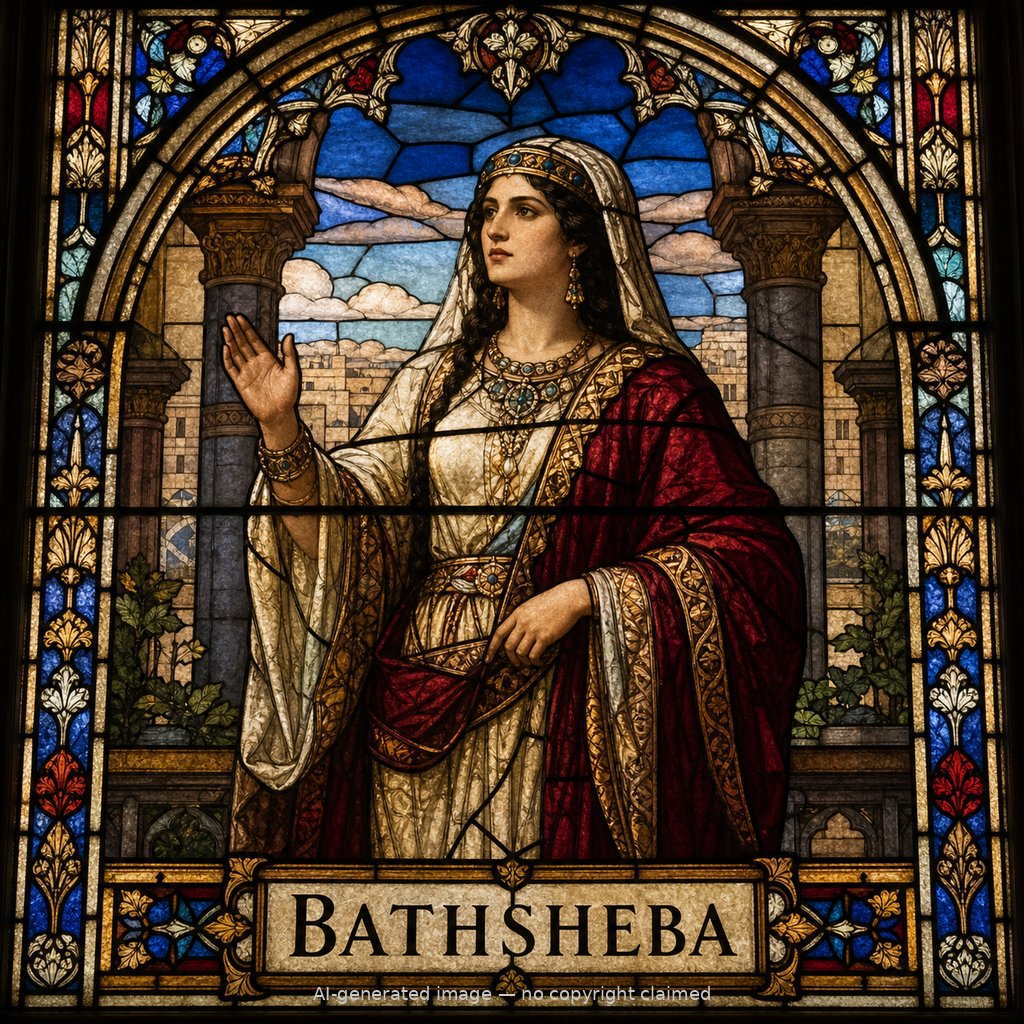
Bathsheba (F)
First named in 2 Samuel 11
While her husband Uriah, one of David's elite warriors, was at war, David saw Bathsheba bathing, sent for her, and she came; when she conceived, David recalled Uriah to sleep with his wife to cover it up, and when Uriah refused out of loyalty to his fellow soldiers, David had him killed in battle (2 Samuel 11:2-21). Scripture assigns the moral verdict plainly and only to David: 'the thing that David had done was evil in the sight of the LORD' (2 Samuel 11:27). On learning of Uriah's death, Bathsheba mourned him, and only afterward was she brought into David's house as a wife (2 Samuel 11:26-27). The prophet Nathan confronted David with a parable in which David alone is condemned; God's judgment included the death of the child born from the affair (2 Samuel 12:1-19). Their second son was Solomon, given the name Jedidiah, 'beloved of the LORD,' by Nathan — grace following judgment (2 Samuel 12:24-25). Decades later, with David old and Adonijah moving to seize the throne, Bathsheba acts decisively: at Nathan's urging, she reminds David of his oath that Solomon would reign, securing his public confirmation before he died (1 Kings 1:11-31). After Solomon's coronation, Bathsheba appears again as queen mother, carrying a request from Adonijah that Solomon reads as a renewed threat and answers by executing him (1 Kings 2:13-25). Matthew's genealogy of Jesus names her, pointedly, as 'the wife of Uriah' (Matthew 1:6) — grace, not respectability, shaping the Messiah's ancestry.
Thought for Today
Nathan's parable named David alone as guilty for what happened to Bathsheba and Uriah, and after judgment fell on their first child, their second son was given the name Jedidiah -- "beloved of the LORD." Grace really can follow judgment that closely; Jesus is where that grace is finally made permanent.
References: 2 Samuel 11; 2 Samuel 12:1-25; 1 Kings 1; 1 Kings 2:13-25; Matthew 1:6
Genealogy
Connections
- Ancestor of Christ (Matthew 1:6)
- Bathsheba (F) — bore → Solomon (M)
- David (M) ↔ married ↔ Bathsheba (F)
- Eliam (M) — begot → Bathsheba (F)
- Bathsheba (F) — bore → Shammua (M)
- Bathsheba (F) — bore → Shobab (M)
- Bathsheba (F) — bore → Nathan (M)
- Uriah (M) ↔ married ↔ Bathsheba (F)
- Bathsheba (F) — secured the throne for → Solomon (M)
When David was old and Adonijah moved to seize the throne, Bathsheba went to David at Nathan's urging and secured his public confirmation that Solomon would reign.
1 Kings 1:11-31