 Lives of Scripture
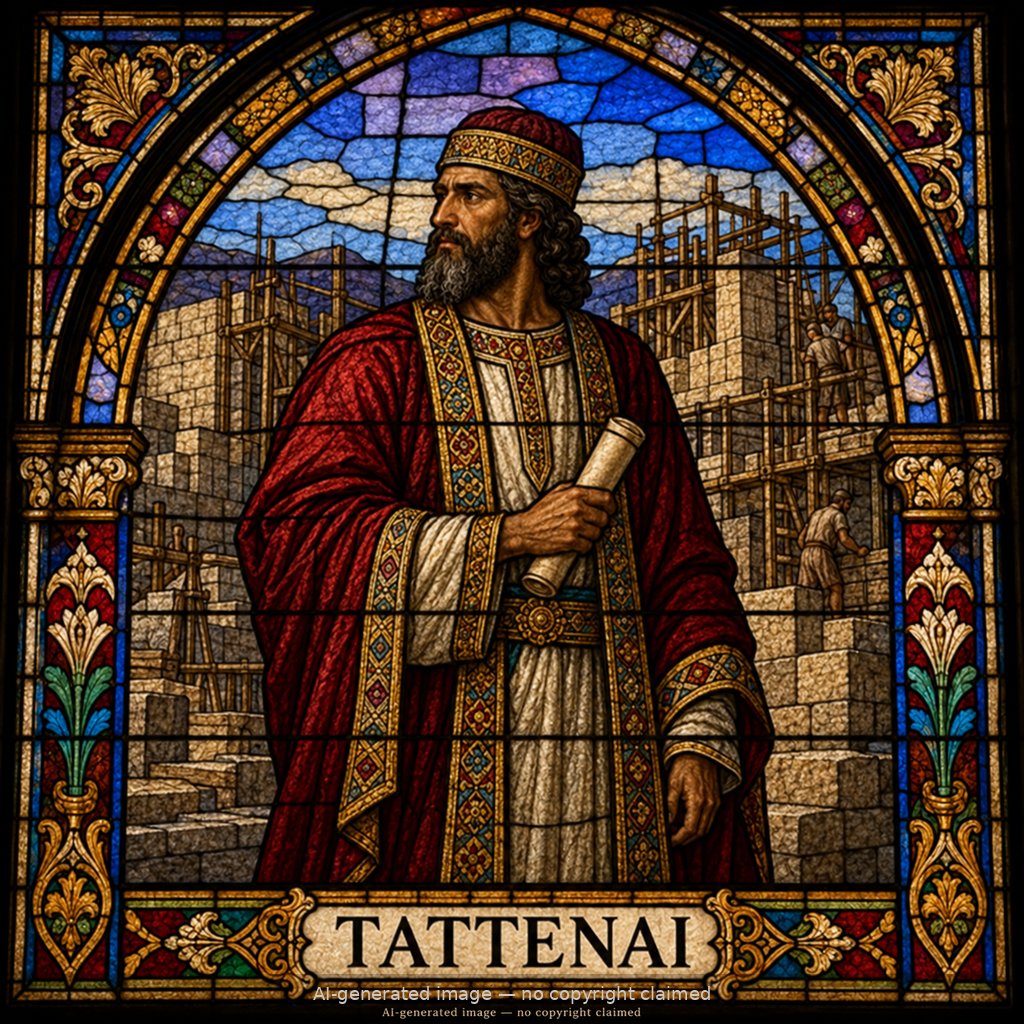
Tattenai (M)
First named in Ezra 5:3-6
Tattenai was the Persian governor of the province Beyond the River, the vast territory west of the Euphrates that included Judah, during the reign of Darius I (Ezra 5:3). After years of delay, the returned exiles had resumed rebuilding the temple in Jerusalem under Zerubbabel and Jeshua son of Jozadak, stirred up by the prophets Haggai and Zechariah (Ezra 5:1-2). Tattenai, with Shethar-bozenai and their colleagues, came to Jerusalem, demanded to know who had authorized the building, and asked for the names of the men in charge (Ezra 5:3-4). Scripture notes that God was watching over the elders of the Jews, so the officials did not halt the work while the matter went to the king (Ezra 5:5). Tattenai's letter to Darius was a fair report: it described the work, set out the Jews' own account that Cyrus had decreed the rebuilding, and asked the king to search the royal archives (Ezra 5:6-17). The decree was found at Ecbatana, and Darius ordered Tattenai to keep away from the work, pay its full cost from the province's royal taxes, and supply what the priests needed for the daily sacrifices (Ezra 6:1-12). Tattenai and his colleagues carried out the order diligently, and the temple was finished (Ezra 6:13-15). Outside Scripture, a Babylonian tablet from Darius's reign names a Tattannu as governor of Across-the-River, commonly identified with him.
Thought for Today
Tattenai came to question the temple builders, but God was watching over them, so the work went on while the king decided. In the end the governor paid the costs from the king's taxes. When people question what God has given us to do, we can keep at it and trust Him with the outcome.
References: Ezra 5:3-6; Ezra 6:6-13
Genealogy
Father
—Mother
—Spouse(s)
—Children
—Connections
- Tattenai (M) ↔ questioned the temple rebuilding together ↔ Shethar-bozenai (M)
As governor of Beyond the River, Tattenai went to Jerusalem with Shethar-bozenai to ask who had authorized the temple rebuilding; the two sent a joint report to King Darius and later carried out his decree together.
Ezra 5:3-6; Ezra 6:6-13
- Tattenai (M) — challenged his authority to rebuild the temple → Zerubbabel (M)
Tattenai demanded to know who had authorized the temple work Zerubbabel was leading, but did not stop it while the question went to Darius; once the king confirmed Cyrus's decree, Tattenai funded the work instead.
Ezra 5:2-5; Ezra 6:7-13
- Tattenai (M) — challenged his authority to rebuild the temple → Jeshua (M)
Jeshua son of Jozadak was leading the temple rebuilding alongside Zerubbabel when Tattenai came to Jerusalem to question who had authorized it.
Ezra 5:2-5
- Darius (M) — ordered him to fund the temple rebuilding → Tattenai (M)
Tattenai reported the temple rebuilding to Darius and asked for a search of the royal archives; when Cyrus's decree was found, Darius ordered Tattenai to keep away from the work and pay its costs from the province's royal taxes, and Tattenai obeyed.
Ezra 5:6-17; Ezra 6:6-13