 Lives of Scripture
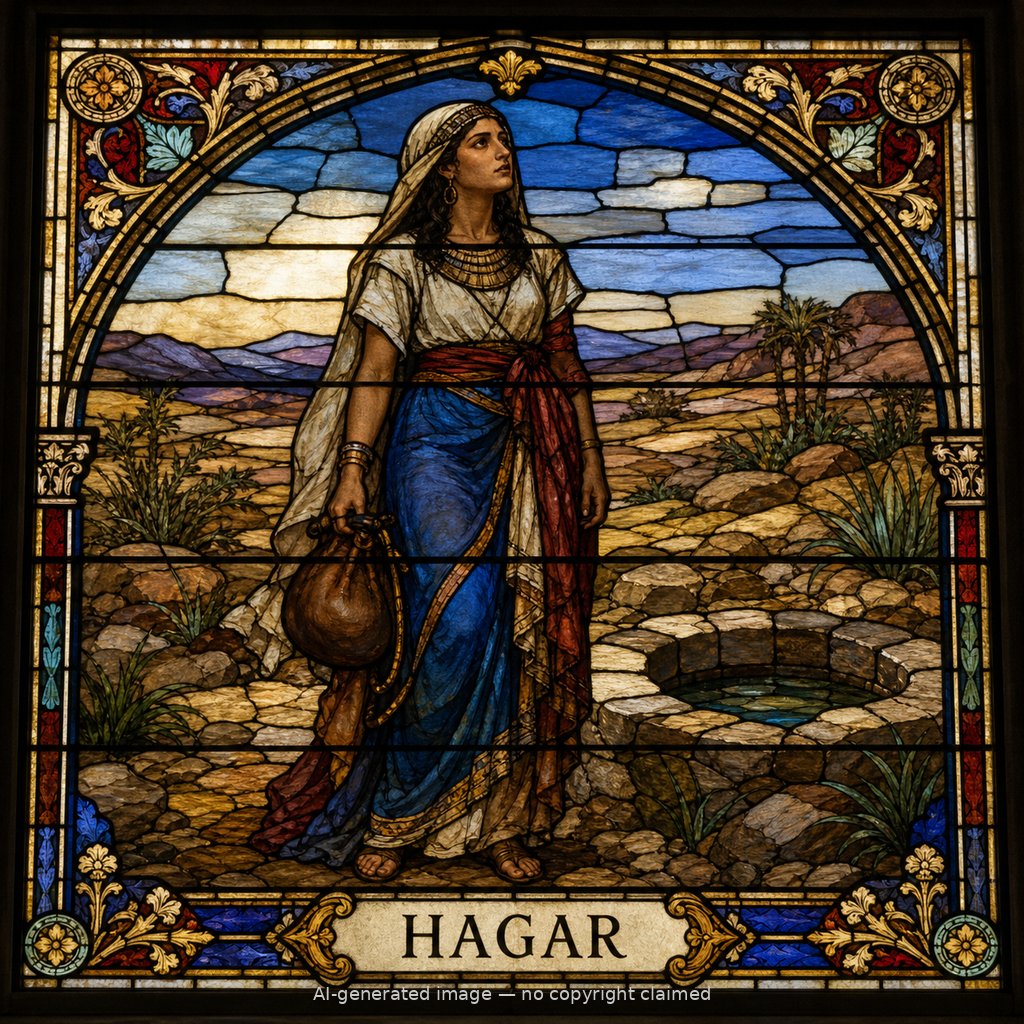
Hagar (F)
First named in Genesis 16
Hagar was Sarai's Egyptian servant, given to Abram as a wife so the barren Sarai could obtain a family through her — a solution Scripture frames as a lack of trust in God's promise (Genesis 16:1-3). Once pregnant, Hagar looked on her mistress with contempt, and Sarai treated her so harshly that Hagar fled (Genesis 16:4-6). At a spring, the angel of the LORD found her — Scripture's first angelic appearance — telling her to return to Sarai, while promising her son would father a multitude (Genesis 16:7-12). Hagar responded by naming God 'El Roi,' the God who sees — Scripture's first instance of a person naming God (Genesis 16:13-14). She returned and bore Ishmael. After Isaac's weaning, Sarah demanded Hagar and her son be cast out; Abraham was distressed, but God told him to listen to Sarah, again promising Ishmael would become a great nation (Genesis 21:8-13). Sent away with only bread and water, Hagar wandered until the water ran out; unable to watch her son die, she wept at a distance until God heard his cry and opened her eyes to a well she had not seen (Genesis 21:14-19). Ishmael grew up in Paran, became an archer, and Hagar arranged an Egyptian wife for him (Genesis 21:20-21). Paul later uses Hagar and Sarah allegorically to contrast slavery under law with freedom under promise — a theological application, not a claim about Hagar's own standing before God, whom Genesis shows caring for her directly, by name, twice (Galatians 4:21-31).
Thought for Today
Fleeing into the wilderness, Hagar became the first person in Scripture to name God herself: 'El Roi,' the God who sees. Long before Jesus was born, God already noticed a single desperate, unnamed servant, and Jesus shows us that same personal attention still holds true today.
References: Genesis 16; Genesis 21:8-21; Galatians 4:21-31
Genealogy
Connections
- Hagar (F) — bore → Ishmael (M)
- Abraham (M) ↔ married ↔ Hagar (F)
- Sarah (F) ↔ clashed with ↔ Hagar (F)
Hagar showed contempt for Sarah once pregnant with Abraham's child, and Sarah in turn dealt harshly with Hagar, then later insisted Abraham cast out both Hagar and Ishmael.
Genesis 16:4-6; Genesis 21:8-14
Places
- Canaan — Sarah's servant, given to Abram in this land to bear a son
Genesis 16:3
- Egypt — an Egyptian, Sarah's servant and the mother of Ishmael
Genesis 16:1
- Wilderness of Paran — wandered in this wilderness with Ishmael, where God showed her a well
Genesis 21:14-19
- Wilderness of Shur