 Lives of Scripture
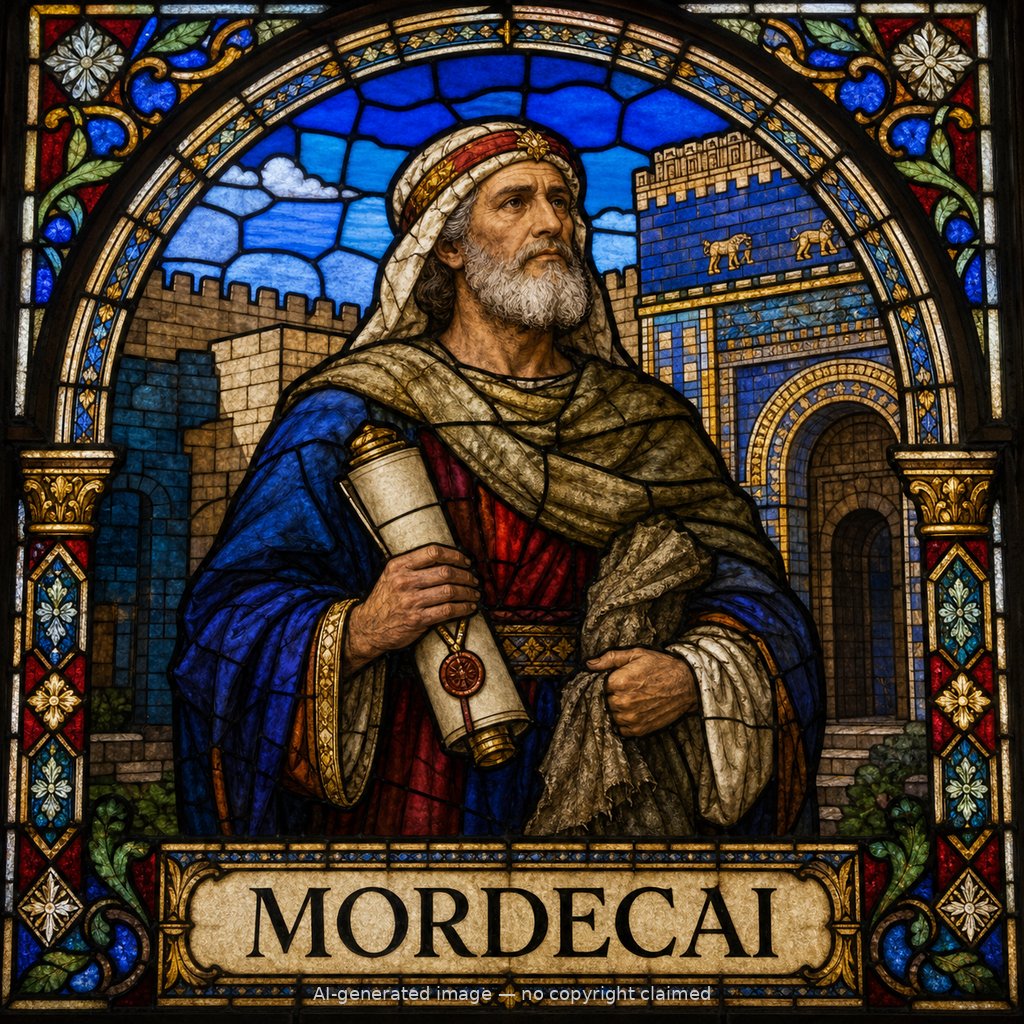
Mordecai (M)
First named in Esther 2:5-22
Mordecai, a Jewish exile living in Susa descended from the tribe of Benjamin, raised his younger cousin Hadassah -- known as Esther -- after the death of her parents, treating her as his own daughter (Esther 2:5-7). When Esther was taken into the king's harem and eventually chosen as queen, Mordecai instructed her not to reveal her Jewish identity, and continued to watch over her welfare from outside the palace (2:10-11). He soon uncovered a conspiracy by two of the king's officers to assassinate King Ahasuerus, reported it through Esther, and the plot was foiled and recorded in the royal chronicles (2:21-23). Trouble arose when Mordecai refused to bow before Haman, an official recently elevated above all other princes; enraged, and learning Mordecai was a Jew, Haman schemed not merely to punish Mordecai but to destroy all Jews throughout the Persian empire, securing a royal decree for their annihilation (3:2-13). Mordecai responded with public mourning and urgently pressed Esther to intercede with the king, warning her that silence would not spare her and asking, 'Who knows whether you have not attained royalty for such a time as this?' (4:14). Esther agreed to risk her life by appearing before the king unsummoned. In a dramatic reversal, the king that same night discovered Mordecai's earlier, unrewarded service in exposing the assassination plot, and forced Haman -- who had built gallows intending to hang Mordecai -- to instead publicly honor him (6:1-11). Haman was ultimately hanged on his own gallows (7:9-10), and Mordecai was elevated to Haman's former position, becoming second in rank to the king himself, using his authority to secure the Jews' defense and establish the festival of Purim commemorating their deliverance (8:1-2, 15; 9:20-22; 10:2-3).
Thought for Today
Mordecai refused to bow to Haman and warned Esther that she might have 'attained royalty for such a time as this.' Jesus calls us, too, to use whatever position we hold for others rather than only for our own safety, even when the cost is real.
References: Esther 2:5-22; Esther 3:2-6; Esther 4:1-17; Esther 5:9-14; Esther 6:2-13; Esther 7:9-10; Esther 8:1-15; Esther 9:3-31; Esther 10:2-3
Genealogy
Connections
Places
- Susa — the Jew at the king's gate here, raised to second in the kingdom
Esther 2:19-21; Esther 10:3