 Lives of Scripture
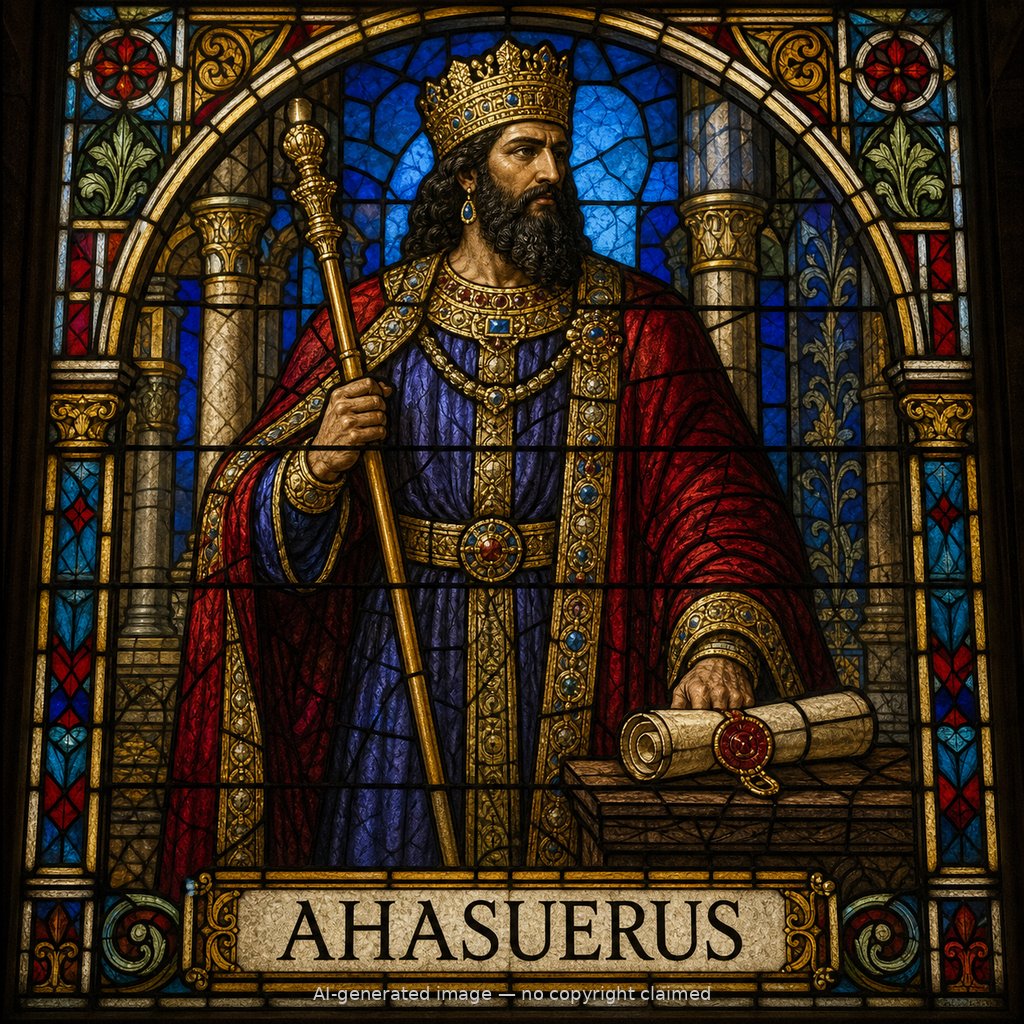
Ahasuerus (M)
First named in Ezra 4:6
Ahasuerus reigned as king over Persia's vast empire, "from India to Cush," ruling from the citadel of Susa (Esther 1:1). After Queen Vashti refused to appear at his banquet before his officials, Ahasuerus deposed her on his advisors' counsel and later selected Esther -- a Jewish orphan raised by her cousin Mordecai, who had concealed her ethnicity -- as his new queen through an empire-wide search (Esther 2:1-17). When Haman, the king's highest official, was enraged that Mordecai would not bow to him, he manipulated Ahasuerus into approving an irrevocable decree to annihilate the Jewish people throughout the empire, offering a huge sum for the privilege (3:1-11) -- the king approved it without apparently grasping its full weight or Esther's own identity. At great personal risk, Esther approached the king uninvited, exposed Haman's plot at a banquet, and revealed she herself was Jewish (7:1-6). Ahasuerus's fury turned on Haman, who was hanged on the very gallows he had built for Mordecai (7:9-10). The king then permitted the Jews to defend themselves against the decree's still-standing effect and elevated Mordecai to Haman's former position (8:1-17). Ahasuerus comes across throughout Esther as a powerful but impulsive and easily swayed ruler, whose decisions were repeatedly shaped by the people around him -- for both harm and eventual good.
Thought for Today
Ahasuerus signed a decree to destroy an entire people without even realizing his own queen was one of them, until Esther's courage exposed it just in time. God's providence was working through an unaware and impulsive king, the same quiet providence that kept working until Jesus was born of that same threatened people.
References: Ezra 4:6; Esther 1:1-19; Esther 2:1-21; Esther 3:1-12; Esther 6:2; Esther 7:5; Esther 8:1-12; Esther 9:2-30; Esther 10:1-3; Daniel 9:1
Genealogy
Connections
- Ahasuerus (M) ↔ married ↔ Vashti (F)
- Ahasuerus (M) ↔ married her, then spared her people ↔ Esther (F)
Ahasuerus chose Esther as queen after an empire-wide search, and when she risked her life by approaching him uninvited to expose Haman's plot to destroy the Jews, he had Haman executed and allowed the Jews to defend themselves against the standing decree.
Esther 2:1-17; Esther 5:1-8; Esther 7:1-10; Esther 8:1-17
- Ahasuerus (M) — had him executed on his own gallows → Haman (M)
Ahasuerus had elevated Haman above all his other officials and unknowingly approved his decree to destroy the Jewish people. When Esther exposed Haman as the plot's architect at her second banquet, the king's fury turned on him and he had Haman hanged on the very gallows Haman had built for Mordecai.
Esther 3:1-11; Esther 7:1-10
- Ahasuerus (M) — elevated him to Haman's former position → Mordecai (M)
When King Ahasuerus discovered that Mordecai's earlier exposure of an assassination plot had gone unrewarded, he had Haman himself parade Mordecai through the city in royal honor, and after Haman's fall the king gave Mordecai his signet ring and elevated him to the empire's highest office.
Esther 6:1-11; Esther 8:1-2
Places
- Susa — the Persian king who reigned from this citadel and made Esther queen
Esther 1:2; Esther 2:16-17