Lives of Scripture
Hur (M)
First named in Exodus 17:10-12
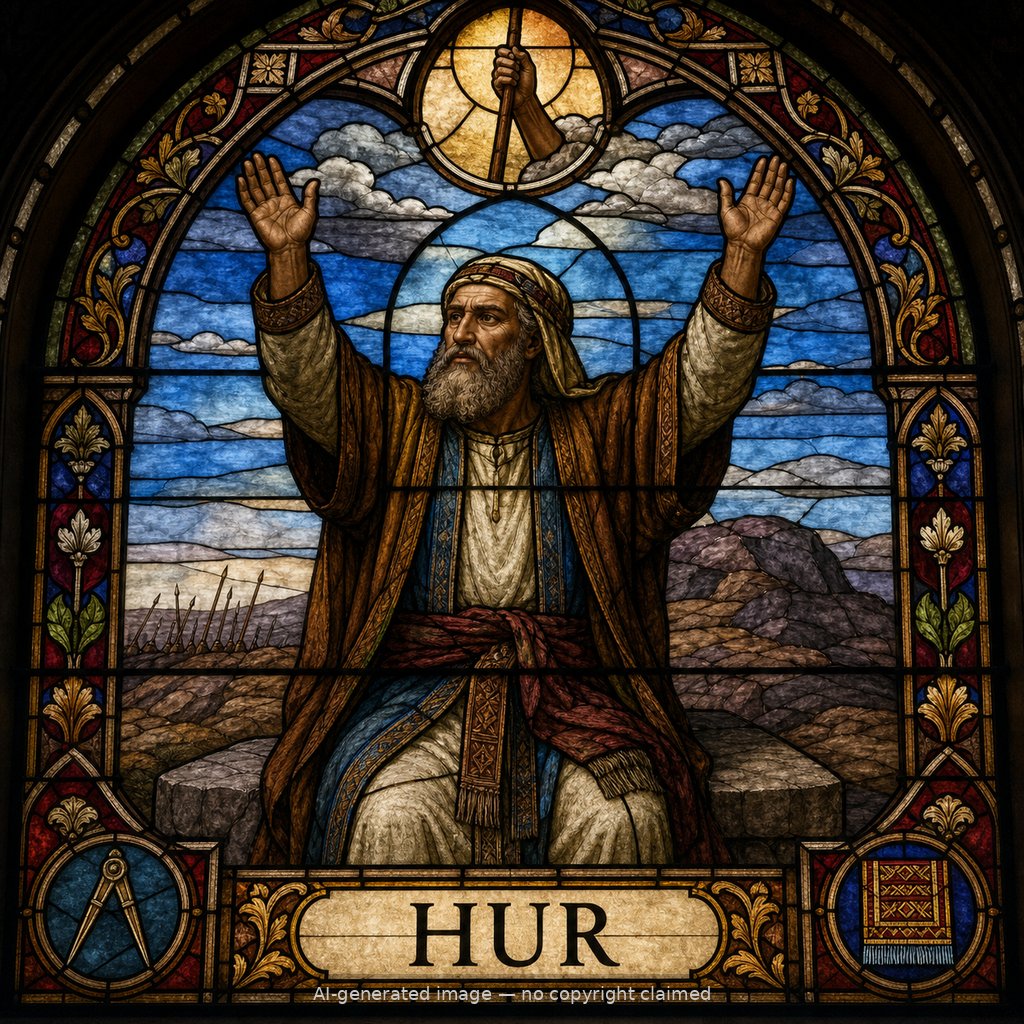
Hur first appears at Rephidim during Israel's battle against Amalek. As Joshua led Israel's fighting men, Moses stood on a hilltop holding up the staff of God, and "whenever Moses held his hand up, Israel prevailed, and whenever he let his hand down, Amalek prevailed" (Exodus 17:11). When Moses' arms grew heavy, Aaron and Hur set a stone under him to sit on, then "supported his hands, one on one side and one on the other," steadying them until sunset and Israel's victory (17:12-13). Later, as Moses prepared to ascend Mount Sinai to receive the law, he left Aaron and Hur in charge of the people below, telling the elders, "whoever has a legal matter, let him approach them" (24:14) -- a position of real civil authority during Moses' forty-day absence, the same period in which the people made the golden calf. Genealogies in 1 Chronicles identify Hur as a son of Caleb of the tribe of Judah and the father of Uri, whose son Bezalel became the tabernacle's master craftsman, filled by God's Spirit "with skill, with intelligence, with knowledge and in all craftsmanship" (Exodus 31:2-3; 1 Chronicles 2:19-20). Hur is never given his own speech or crisis in Scripture, but he appears twice at pivotal moments of Israel's wilderness leadership, and his family line produced the man who built the tabernacle itself.
Thought for Today
Hur held up Moses' tired hands with Aaron until Israel's battle against Amalek was won. Jesus never grows weary interceding for us, His hands lifted on our behalf.
References: Exodus 17:10-12; Exodus 24:14; Exodus 31:2; Exodus 35:30; Exodus 38:22; 1 Chronicles 2:19-50; 1 Chronicles 4:1-4; 2 Chronicles 1:5
Genealogy
Connections
Places
- Mount Sinai — held up Moses's hands, and was left in charge while Moses climbed the mountain
Exodus 17:12; Exodus 24:14
- Rephidim