 Lives of Scripture
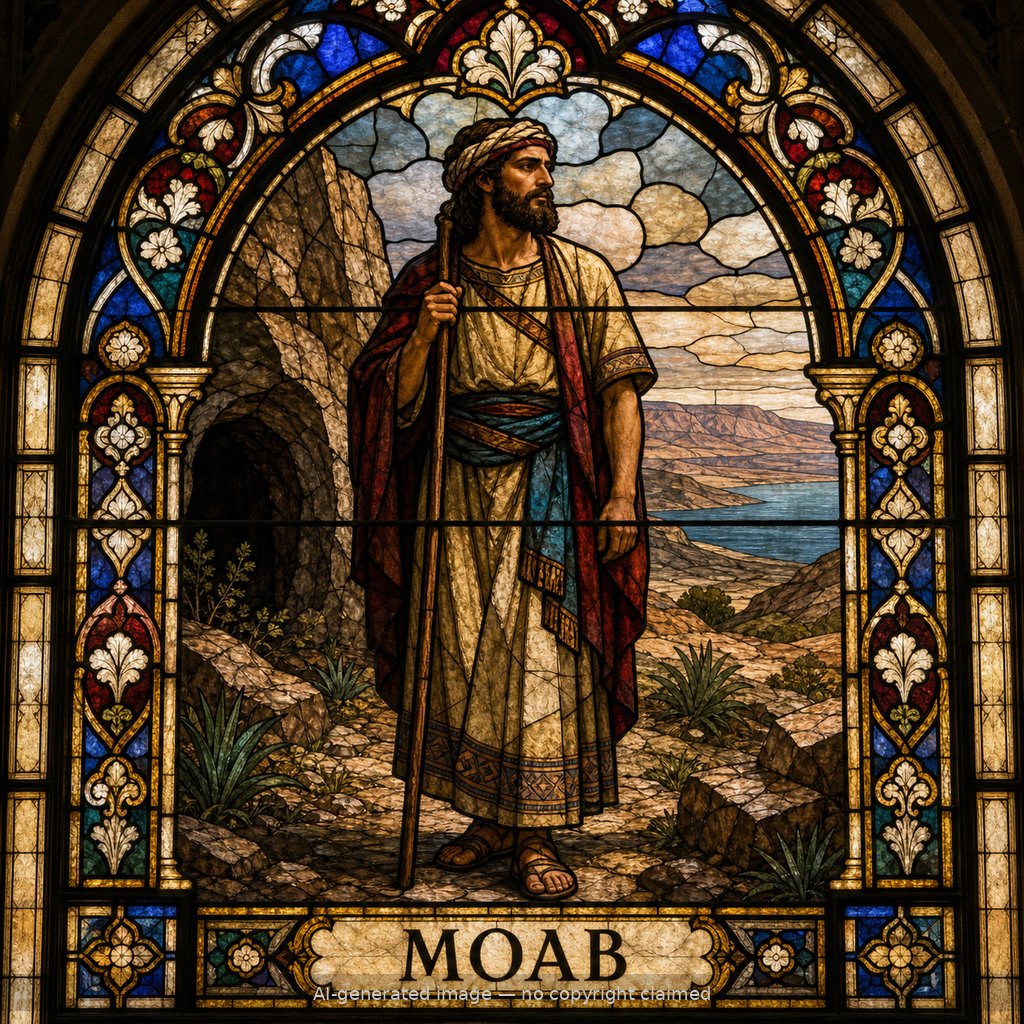
Moab (M)
First named in Genesis 19:37
Moab's origin is recorded in one of the more difficult passages of Genesis. After the destruction of Sodom and Gomorrah, Lot and his two daughters took refuge in a cave in the hill country, having lost Lot's wife on the way (Genesis 19:26, 30). Believing there were no other men left to give them children -- an assumption Scripture does not confirm as accurate, since Zoar, a nearby town, had just been spared at their own request (19:20-22) -- the daughters made a plan: on successive nights they gave their father wine and slept with him while he was too intoxicated to be aware, each conceiving a son (19:31-36). Scripture states this plainly, without excusing Lot's drunkenness or his daughters' scheme, consistent with its wider pattern of recording its characters' sins honestly rather than hiding them. The older daughter named her son Moab -- an etymology traditionally understood to mean 'from father,' openly memorializing the shameful circumstance of his conception (19:37). Moab grew to become 'the father of the Moabites to this day,' a nation that settled east of the Dead Sea and figures repeatedly in Israel's later history -- sometimes as an antagonist, as in Balak's attempt to curse Israel through Balaam (Numbers 22-24) and Israel's later sin with Moabite women at Baal-peor (Numbers 25:1), and sometimes surprisingly, as the homeland of Ruth, a Moabite woman who became an ancestor of King David and, through him, of Christ (Ruth 1:4; 4:17; Matthew 1:5).
Thought for Today
Moab's very name, 'from father,' memorialized the shameful circumstances of his conception in a cave outside Sodom, and Scripture states the story plainly rather than hiding it. Jesus does not need our origins cleaned up before He'll claim us; He works with exactly the story we actually have.
References: Genesis 19:37; Genesis 36:35; Numbers 25:1; 2 Chronicles 20:1-23
Genealogy
Connections
Places
- Zoar — conceived by Lot's older daughter in the hills above this town
Genesis 19:30-37