 Lives of Scripture
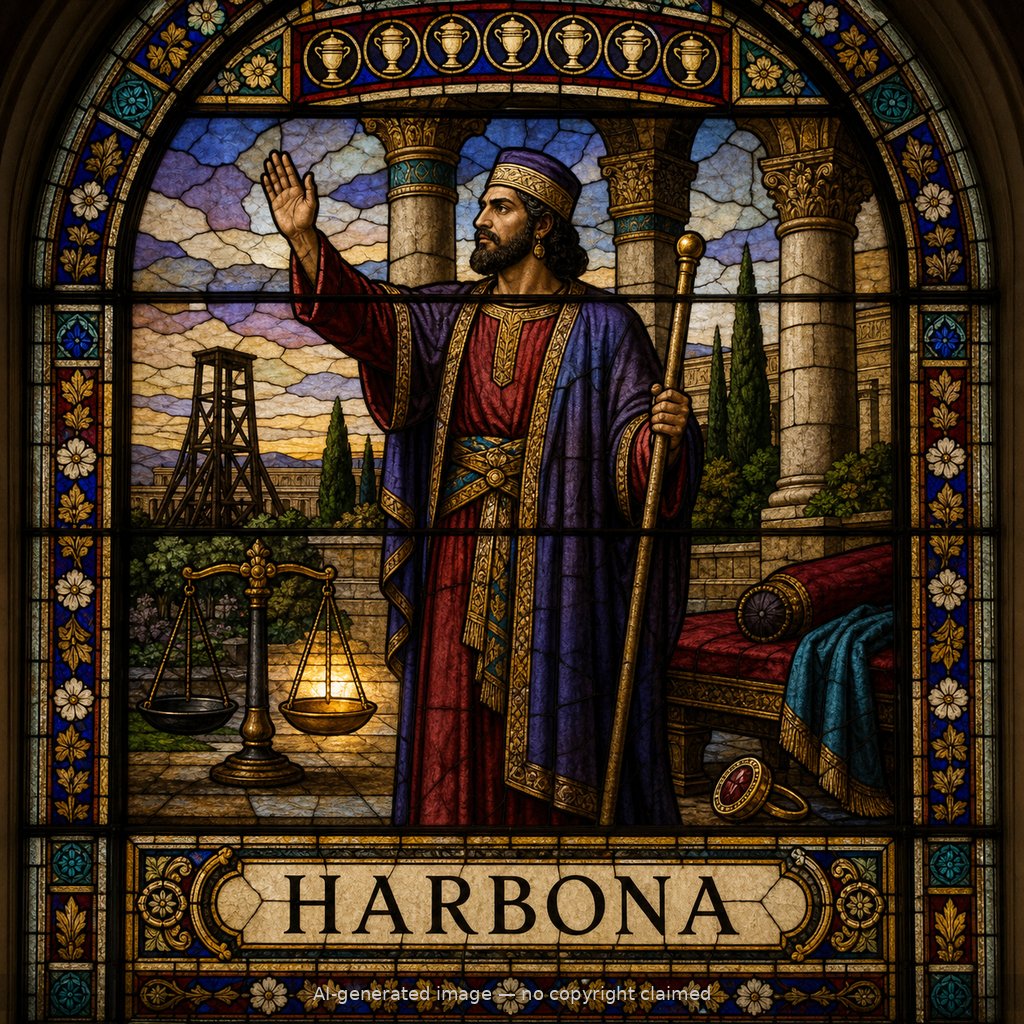
Harbona (M)
First named in Esther 1:10
Harbona appears twice in the book of Esther as one of the seven eunuchs who personally served King Ahasuerus of Persia (Esther 1:10). His decisive moment comes at the climax of the story, during Queen Esther's second banquet, when she exposed Haman's plot to destroy her people and identified him before the king as "a foe and an enemy" (7:1-6). As the enraged king stepped out into the palace garden and Haman, in desperation, fell across Esther's couch pleading for his life, the king returned to find what looked like an assault on the queen (7:7-8). At that moment, Harbona spoke up: "Behold indeed, the gallows standing at Haman's house fifty cubits high, which Haman made for Mordecai who spoke good on behalf of the king!" (7:9). The king immediately ordered, "Hang him on it," and Haman was executed on the very structure he had built for his intended victim (7:9-10). Harbona's single, well-timed sentence turns out to be the hinge that seals Haman's downfall and clears the way for Mordecai's rise and the Jews' deliverance later in the book. Nothing else is recorded of him, but his brief intervention fits Esther's larger pattern of God's unseen providence working through ordinary court officials at exactly the right moment.
Thought for Today
Harbona's single sentence about Haman's gallows sealed the wicked plot's collapse and Israel's rescue. God still works through small, unnamed moments to accomplish salvation, fully in Jesus.
References: Esther 1:10; Esther 7:9
Genealogy
Father
—Mother
—Spouse(s)
—Children
—Places
- Susa — the king's eunuch here, who pointed out Haman's gallows
Esther 7:9