 Lives of Scripture
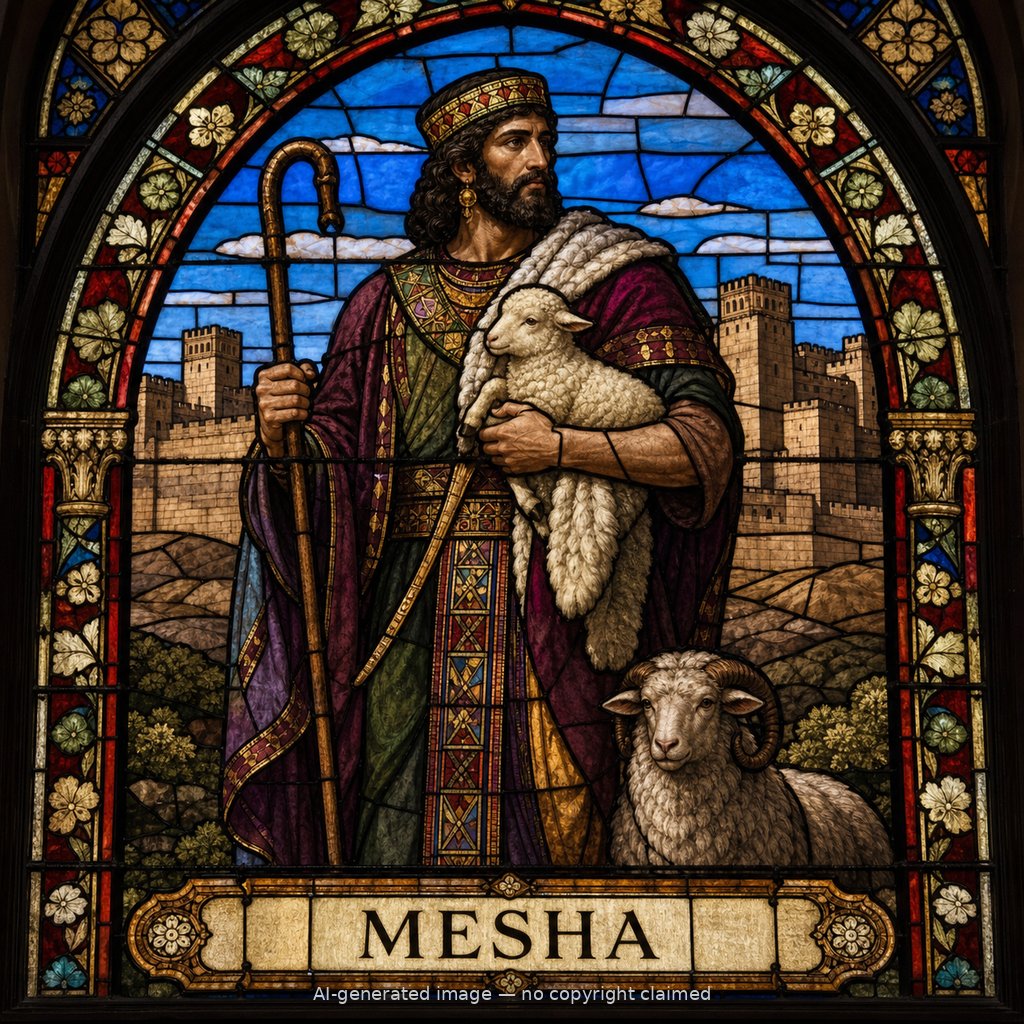
Mesha (M)
First named in 2 Kings 3:4-26
Mesha, king of Moab, is introduced in 2 Kings 3 as a sheep breeder who had paid Israel a heavy annual tribute of lambs and wool, but who 'rebelled against the king of Israel' after Ahab's death (3:4-5). King Jehoram of Israel responded by allying with Jehoshaphat of Judah and the king of Edom to invade Moab. After their armies nearly perished from lack of water in the wilderness, the prophet Elisha intervened, promising both water and victory (3:9-19). The coalition routed Moab's forces and besieged Mesha's remaining stronghold at Kir-hareseth (3:24-25). Cornered, Mesha attempted a desperate breakout with seven hundred swordsmen to reach the king of Edom, but failed (3:26). In his final desperation, he took 'his oldest son who was to reign in his place, and offered him as a burnt offering on the wall' (3:27) -- a shocking act of child sacrifice to his god Chemosh, offered in the sight of the besieging armies. Scripture records that 'there came great wrath against Israel, and they departed from him and returned to their own land' (3:27), a verse whose meaning is debated among interpreters but which at minimum marks the campaign's abrupt, unsettling end. Mesha's story is preserved in Scripture without any softening of its horror, a stark picture of pagan desperation contrasted with the true God who explicitly forbids child sacrifice (Leviticus 18:21; Deuteronomy 12:31).
Thought for Today
In desperation, Mesha sacrificed his own son to a false god to save his city. God, unlike Mesha, gave His willing Son in love to save us.
References: 2 Kings 3:4-26
Genealogy
Father
—Mother
—Spouse(s)
—Children
—Places
- Kir-hareseth — Moab's king, besieged here, who sacrificed his own firstborn son on the wall
2 Kings 3:26-27
- Moab — its king, who rebelled against Israel and sacrificed his own son
2 Kings 3:4-5; 2 Kings 3:27