Lives of Scripture
Salome
First named in Matthew 14:6-11
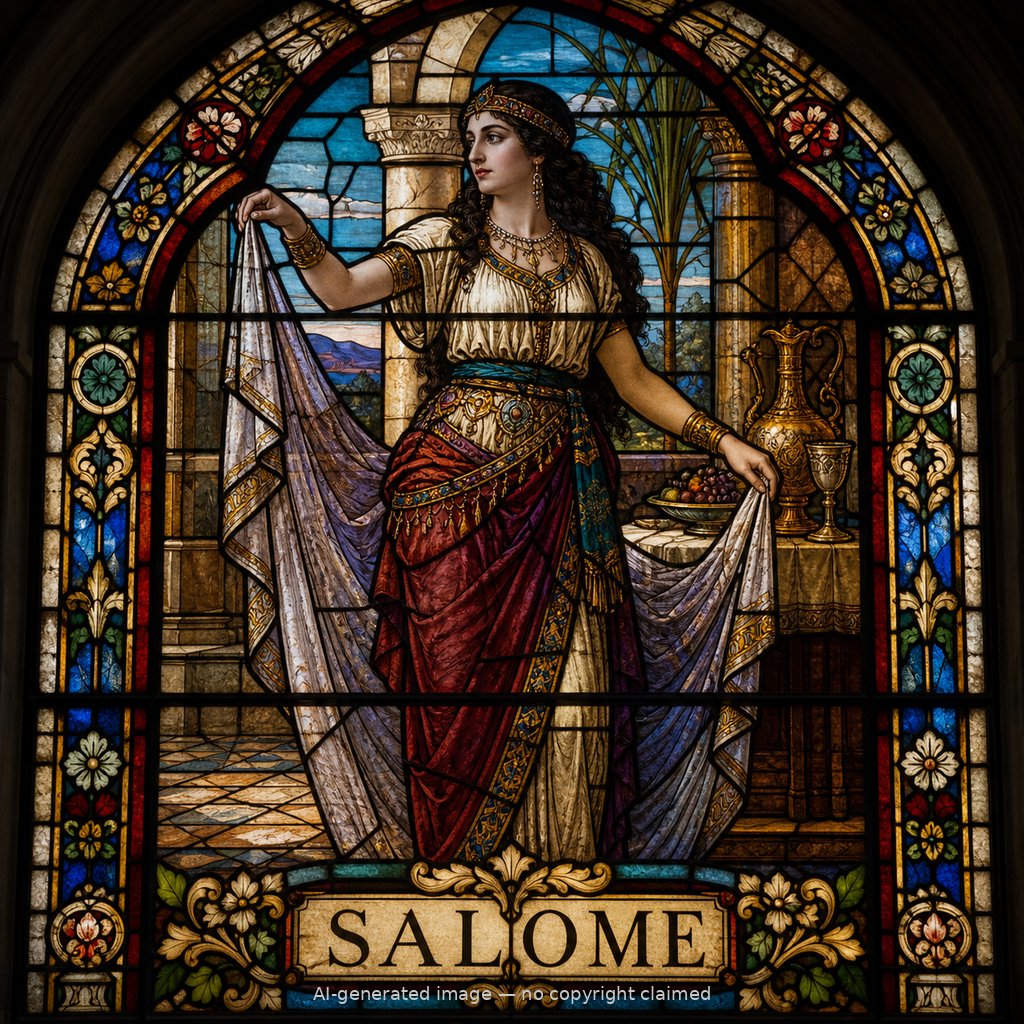
Herodias's daughter, unnamed in the Gospels but identified as Salome by the first-century historian Josephus, danced before Herod Antipas and his dinner guests at his birthday banquet, pleasing him so thoroughly that he swore an oath in front of everyone present to give her whatever she asked, up to half his kingdom (Mark 6:21-23). Rather than answering immediately, she went out to consult her mother Herodias, who had long wanted John the Baptist dead for publicly condemning her marriage to Herod: 'What shall I ask for?' (6:24). Instructed by her mother, she hurried back in and made the request specific and immediate: 'I want you to give me right away the head of John the Baptist on a platter' (6:25). Herod, though 'deeply grieved,' felt bound by his public oath and the presence of his guests, and had John beheaded in prison, delivering the head to the girl, who in turn gave it to her mother (6:26-28). Scripture records no independent motive of her own beyond her mother's instruction, and no further account of her afterward. Her role in the account -- a young woman whose skill pleased a powerful man enough to draw a reckless, binding promise, then used as the direct instrument to carry out someone else's vengeance -- illustrates how being caught up in another's agenda, even without originating the evil, still carries real and sobering consequences.
Thought for Today
Salome's request, urged by her mother, ended the life of John, who had pointed the way to Jesus. May we resist being used to carry out another's wrong.
References: Matthew 14:6-11; Mark 6:22-28
Genealogy
Places
- Galilee — Herodias's daughter, whose dance in this region cost John the Baptist his head
Mark 6:22-28